
If your dog loves to swim and will swim for hours and hours and not tire, then having him/her fall into the lake is probably not your biggest concern. You may even be thinking of scrolling past this post….I suggest you don’t. Even if your Fido is a total water dog who would swim lengths of the lake for hours, can you be certain Fido is always going to be able to do that? What if Fido falls in and a boat doesn’t see him? What if that boat wake swamps Fido’s head, and he sucks in water instead of air? What if that boat hits Fido? What if Fido falls in, hits his head, and is unconscious? Can he/she swim then? Can anyone see Fido to help? The one answer to all these questions….probably not.
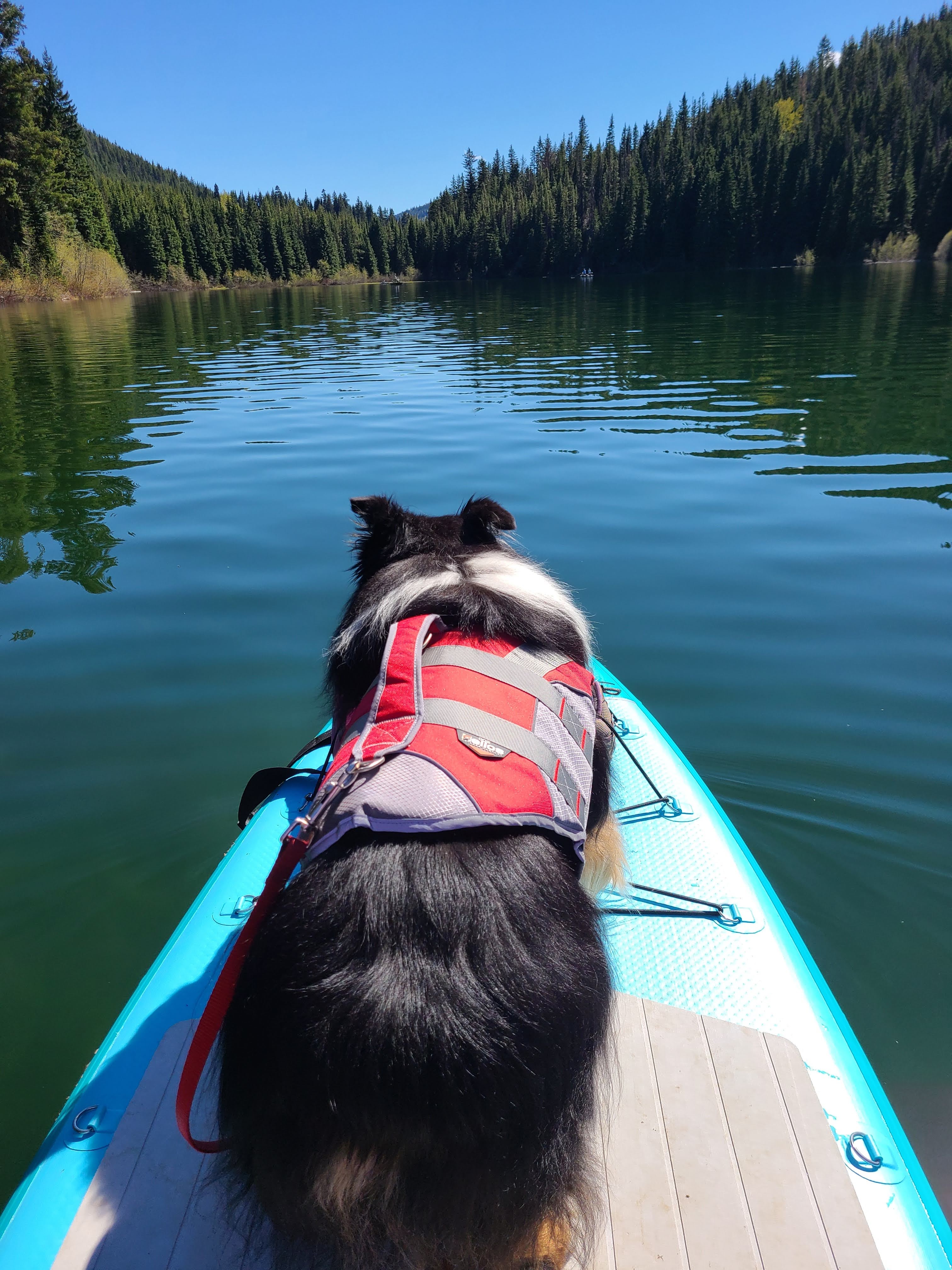
There’s the happy water dog who loves to swim….and then there’s him. Riley is not a water dog. He will wade into the water up to his chest, and then he’s done. If I’m across a stream, he will swim across it to get to me, but he is definitely not happy about it. While he can swim, he is not a strong swimmer. It is so important when SUPing and doing ANY water activity, that you think of the safety not only for yourself but your pup too.
If Riley fell into the water in the middle of the lake he would likely drown before he reached shore. He would tire and he would drown. He is 14 years old, a weak swimmer, and doesn’t like water. A life vest for Riley, and all dogs, should always be a must have item. You never know what the water is going to do or what others on the water are going to see. A respect for the water is what is really needed here. The water is fluid, ever changing, never still. Respect it for what it is and take the precautions to keep yourself and others safe.
There are many options for life vests for us. There are also many options for dogs! The most important part of selecting a life vest for your pup is ensuring it fits properly, allows for natural unhindered movements, and is buoyed appropriately to support the dog. We tried on 6 life vests before finding one that fit Riley in the chest. It was too big in the neck, but the chest fit, and the length was perfect, so we just shortened the neck strap to fit his frame perfectly. If you have a barrel chested dog or a dog with different proportions, then be prepared to make some minor adjustments to the straps on a life vest to ensure a proper fit.
We know there are many reasons the life vests/jackets are important for people to wear. Do those reasons for life vests apply to dogs, too? Let’s find out!
Here are 8 reasons your dog needs a life vest:
1. Life vests save lives
In the 2020 Recreational Boating statistics report from the US Coast Guard, “75% of fatal boating accident victims drowned. Of those drowning victims with reported life jacket usage, 86% were not wearing a life jacket” (2020 Recreational Boating statistics, US Coast Guard, page 7).
Lets think about that for a second. There are 86% of fatal boating victims that are not wearing life preservers. The report also outlines 181 of 335 falls overboard resulting in death (2020 Recreational Boating statistics, US Coast Guard, page 37). That is nearly half! 148 of those deaths were determined to be caused from drowning (37). There are projection reports from the RedCross that estimate up to 90% of fatalities related to drowning could be prevented by the use of a life vest/preserver. This doesn’t mean Life jackets/vests/preservers are fool proof. Accidents and fatalities still happen to those who wear one, but there are significantly fewer fatalities when a life vest is worn.
2. Weather doesn’t matter
Weather really does not matter. You can have a beautiful sunny day on the water and still drown when you fall in. You can have the storm of the century and manage to exit the water safely. A sunny day may get a shift in wind and a sudden storm on a larger lake. The water may feel great in the summer but as you go deeper it gets colder. You are still at risk for hypothermia depending on the body of water you are swimming in. The weather does not matter when you are deciding on wearing a life vest or not.
A sunny day also means there are reflections off the water that make it difficult for boaters and swimmers to see through. A large vessel on the water is quite a bit bigger than the little paddleboard. If the sun hits the water around the board and casts a reflection to that big boat, they can’t see you, it’s just too bright.
So what does matter? Do you and Fido want to make it home safely? That is what matters.
3. Dogs can swim
Yes they can! But so can I. Dogs get tired. Dogs can hit their heads. Dogs can become hypothermic despite their fur. Dogs can breathe in water. Dogs can drown. Not all dogs can swim well.
All these things that happen to people, can happen to your dog. You can be a champion swimmer like Michael Phelps and still drown. Your might think that Labrador that swims all day at the beach will be totally okay to paddle out with you into the ocean. Then he jumps in and starts heading for shore. You think, ‘he’s fine, he can swim for hours’. But then you see your boy’s head starting to dip under water and you realize that ocean water is cold and your dog is tiring. Then you look to the shoreline and you realize there is still a good mile of water to cover. Your dog goes under and he doesn’t come back up.
Even the best swimmers practice safety. A life vest could save your dog in this situation. The dog gets tired, but the vest keeps them afloat so you have time to get to them. The dog can then hang out in the water till you get there and just focus on breathing because they can still breathe. The vest also insulates from the cold water which helps stave off a bit of that hypothermia risk. All these things increase your dog’s chance of surviving, all with one thing…a life vest.
4. They can turn your dog the right way around
Just like a human life vest, doggie vests are designed for upright floatation. The majority of the floatation aid is on the dog’s back and sides of the diaphragm. This is to keep the dog in the optimal position for breathing and rescue. If you were to throw a child into the water in a life jacket, the life jacket/vest is required to turn that child face up in 5 seconds or less (National Standards Canada – Life Jackets, sec. 6, table 4).
If Riley falls in the water on his back or on his side, the life vest turns him vertical as soon as he breaks surface. Dog life-vests are not regulated the same way that human vests are, but that doesn’t mean that there are no standards. Research the vest you are considering and make sure that it meets the needs of your dog, not just you. Weight is a factor, fit is a factor, reflectiveness is a factor, seam reinforcement is a factor, condition is a factor, rescue options are factors. All these things contribute to the effectiveness of the life vest and the vest’s ability to perform in an emergency. Test the vest in shallow water before embarking into deep water. Make sure Fido floats. Make sure if Fido falls in upside down, that the vest turns him/her right side up.
5. Model the behavior – be the example
There are many preventable water accidents. I see many people on the water without a life vest all the time. And yes, on occasion I am one of those people who have my vest on board but not necessarily wearing it. When I am not wearing a vest, I am on a super small puddle of a lake and so close to shore that my SUP fins are scraping bottom. But Riley? He is always in a vest around water. If I am going out on the water further than 10 feet from shore, the vest is worn. Be the example for the kids on the water who think they are invincible. Show them and the other boaters that it can be cool to be safe. Maybe you’ll save a life without even knowing it. Maybe that three year old in the sand saw you looking super cool on your paddleboard and decides they want to be just like you, life vest and all.
6. Accidents happen
Merriam Webster Online Dictionary defines accident as “an unforeseen and unplanned event or circumstance” and “an unfortunate event resulting especially from carelessness or ignorance”.
Life is unpredictable. We as people owe it to ourselves and to our furry companions to be as safe as we can when in the outdoors. Accidents are not preventable. No one plans for an accident to happen. But we can prepare for when they happen. We can mitigate the risk to ourselves and others by taking basic safety precautions. Being safe does not mean you don’t get to enjoy your activities, it just means you get to do so with piece of mind that you and Fido are coming home at the end of the adventure.
7. Keep warm
Life vests/jackets do help you keep warmer in the water. They don’t stop your extremities from getting cold but they help insulate your core to stave off hypothermia. There are a large array of life preservers on the market, not all of them will help with the cold. We live in British Columbia Canada and the water tends to be colder more so than warmer. Insulating Riley from the water was important to me so his vest is a thicker vest with more surface area coverage. It means in cooler months, if he were to fall in, the risk of him freezing before I get to him is reduced. That does not mean that the cold water won’t cause spasms or atrophy upon submersion. But it does mean that I have the chance to warm him up again from the cold April waters. It also means I have to ensure he takes a swim or two on the really hot days so he stays regulated and doesn’t overheat…we don’t get many of these days usually!
8. Reduce water impact
When you are suddenly launched/thrown from a boat or a jet ski or other water power vessel, the impact can cause some serious injuries. A life vest provides a barrier between you and the water which can prevent injuries when you hit the water. It does not mean you won’t break an ankle or an arm but it does mean that those ribs that protect your heart and lungs will survive long enough for rescuers to reach you.
Dogs are smaller than we are. Dog bones are thinner than ours which means they break easier. The likelihood of your dog breaking a bone when thrown from a boat is very real. If your dog breaks a leg, they are not going to be able to swim to you. A life vest means that the broken leg is not a death sentence on the water. It means you know their ribs are protected which means the lungs are protected. This means they can breathe. This means you can get your dog to a vet to fix the leg, and your dog is not drowning when you get to them. Sounds like a pretty good outcome for what could be a dire situation doesn’t it? You and Fido still get to go home together.

Riley’s Life Vest
We bought the Helios Splash-Explore Life Vest. It’s amazing! Very solidly made. The handle on the back is very sturdy and comfortable to pull Riley back up out of the water. It makes his sudden bravery on the water much easier to deal with! We bought the red Helios as I prefer all of Riley’s gear to be red. You can read our full review of the Helios Life Vest here.
Side Note: For those who are not aware, red is the often the color associated with dogs who are highly reactive and/or aggressive. Riley is fear aggressive towards other dogs and does not handle being around dogs he doesn’t know well. He has been attacked 4 times by other dogs so I don’t really blame him for not liking other pups at first meeting. Having his gear be red usually tips off people around me that he doesn’t like dogs, and they ask before approaching or give lots of space as we pass. He is the friendliest pup with people but he doesn’t like to make new doggie friends, he sticks to the ones he’s known forever!
 ASR Adventures